




Haze doesn't just affect the sky, it affects your day. Outdoor plans get cancelled. Windows stay shut. You reach for a mask before stepping out. Even a short walk can leave your throat scratchy or your chest feeling tight. Fine particles in polluted air can affect the respiratory system, and prolonged exposure can place extra stress on the body.
You probably have your N95 masks ready and the air purifiers running, but is your body actually prepared to handle the pollution?
And in 2026, haze across Southeast Asia isn't just back; it's worse.
4 Haze Facts You Should Know This Season
1. In August 2026, Indonesia recorded close to 10,000 fire hotspots, reportedly around ten times the levels seen during the previous two years. (The Straits Times)
2. Official figures indicate that over 200,000 hectares of land in Indonesia have been affected by fires, contributing to smoke and haze across the region. (The Straits Times)
3. On 4 September 2026, Serian in Sarawak recorded a hazardous Air Pollutant Index (API) reading of 518, exceeding the state’s emergency threshold of 500 and highlighting the severity that haze conditions can reach.
4. In Singapore, the central region recorded an unhealthy Pollutant Standards Index (PSI) of 123, while Brunei-Muara and Belait recorded PSI readings of 116 and 107, respectively.
These numbers tell a clear story: haze isn't simply a seasonal inconvenience. It can create prolonged periods of poor air quality that make everyday health protection more important.
And while reducing exposure to polluted air should always be the first priority, there is another part of your daily health routine worth considering: supporting your body's natural defences from within.
Haze Season: Why Everyday Health Matters
Haze contains fine particulate matter, including PM2.5, as well as other pollutants produced by fires. These particles are so small, smaller than a strand of hair, that they slip past your body's natural defences and travel deep into your respiratory system. This is why poor air quality can be particularly uncomfortable and concerning for children, older adults, and people who are more sensitive to air pollution.
These particles can also trigger oxidative stress, tiny bits of cell damage building up faster than your body can repair. Over time, this added strain is part of why haze exposure can leave you feeling run-down.
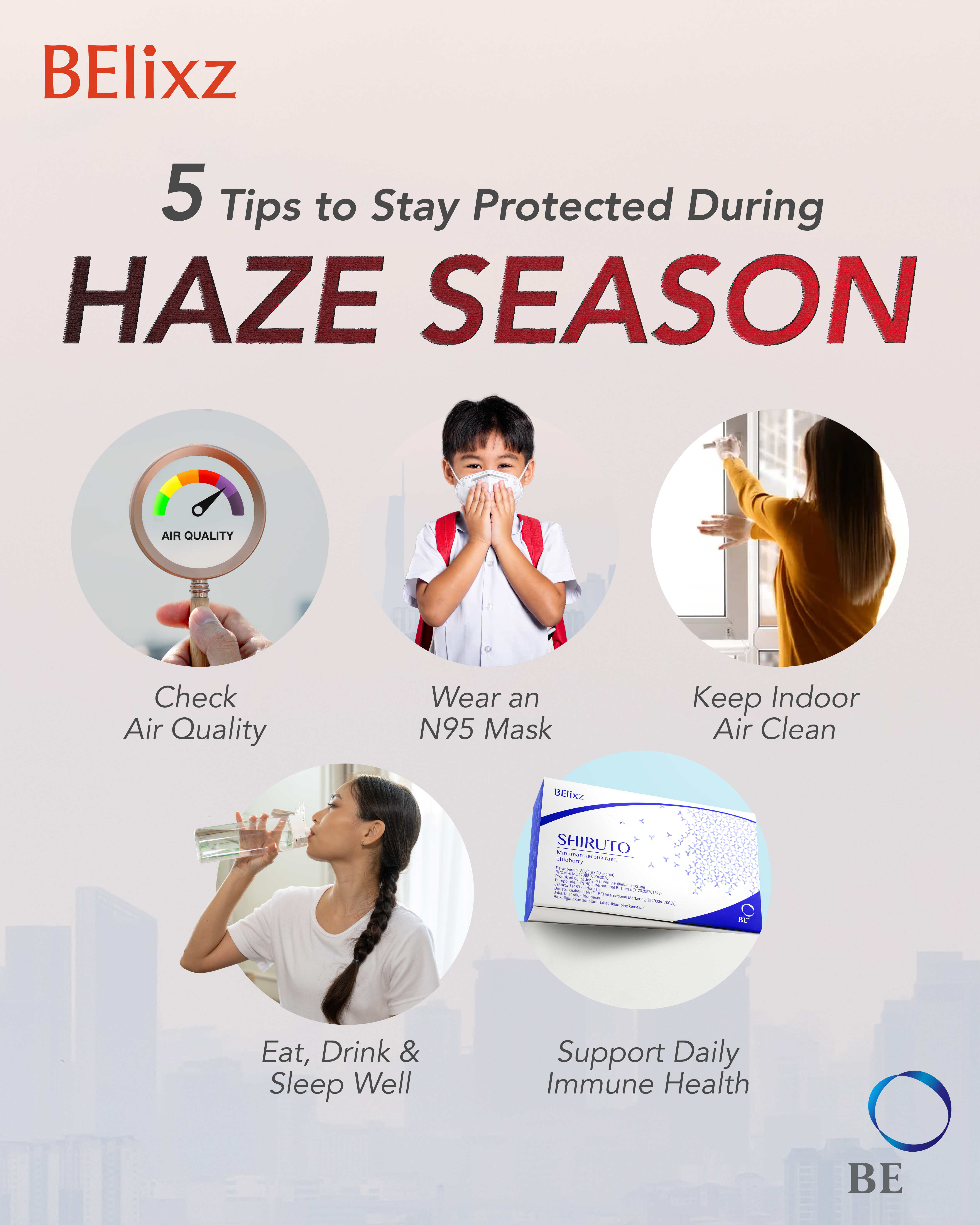
How to Protect Yourself During Haze Season: A Quick Checklist
The first priority is always to reduce your exposure to polluted air. Here’s how:
- Check local API readings and limit outdoor activities when pollution spikes
- Wear the right mask — a fitted N95/particulate respirator, not a loose surgical mask
- Seal your space — keep doors and windows closed, run a portable air cleaner
- Support your body from within — keep up the basics: balanced diet, hydration, enough sleep
- Add daily immune support — because your body's natural defences need daily reinforcement, not just protection when haze is already bad
Why Choose BElixz SHIRUTO During Haze Season?
Maintaining consistent daily habits helps protect your overall well-being before severe haze hits. BElixz SHIRUTO offers targeted nutritional support through three key ingredients working in synergy.
Integrating these nutrients into your diet gives your natural defenses the daily foundation they need to keep you protected from within.
Make Immune Support Part of Your Daily Routine
Haze may be outside your control, but your daily health habits aren't. When air quality deteriorates, take practical steps to reduce your exposure. At the same time, continue giving your body the nutritional support it needs every day.
With IP-PA1, Beta Glucan and Vitamin C, BElixz SHIRUTO is designed to complement your daily wellness routine and support normal immune function. Because looking after your health shouldn't begin only when the skies turn grey.
Stay Protected. Stay Consistent. Stay Strong. Make BElixz SHIRUTO part of your daily immune-health routine during this challenging season.
Frequently Asked Questions
Does haze affect your health?
Yes. Haze can irritate the eyes, nose, throat, and airways, and may cause coughing or difficulty breathing. Children, older adults, and people with existing heart or lung conditions may be more sensitive to poor air quality.
What is PM2.5, and why is it a concern during haze?
PM2.5 is fine particulate matter about 30 times smaller than a human hair. It's small enough to penetrate deep into the lungs and even enter the bloodstream.
What should I do when the API is high?
Limit outdoor activities, avoid strenuous exercise, keep windows closed, and wear a properly fitted N95 when outdoors.
Can supplements help during haze season?
Yes. While reducing exposure to haze should always come first, nutritional support can complement your daily health routine. BElixz SHIRUTO provides IP-PA1, Beta-Glucan and Vitamin C to support normal immune function and your body's natural defences, helping you stay consistent with your wellness routine throughout haze season.
References
- “Indonesian Fires Drive Regional Haze Alerts and School Closures.” The Straits Times, Sept. 2026
- “Haze Besieges Southeast Asia as Indonesia’s Wildfires Blaze Away.” Asia News Network, Sept. 2026
- “Transboundary Air Quality Alert: Southeast Asia.” IQAir, Sept. 2026
- World Health Organization. “Air Pollution: Personal Interventions and Risk Communication.” World Health Organization, Oct. 2024
- World Health Organization. Personal Interventions and Risk Communication on Air Pollution. World Health Organization, 2020
- “Haze: Brunei-Muara Records PSI of 116, Belait 107.” The Star, 3 Sept. 2026
- “Singapore Air Quality Enters Unhealthy Range in Three Regions; NEA Says Haze Could Persist.” CNA, 4 Sept. 2026
- U.S. Environmental Protection Agency (EPA), “Particulate Matter (PM) Basics.”, 2026
- Jeechok, Pakinee. “What Is PM2.5?” Phyathai Hospital, 2020